Introduction
If you’ve seen a large yellow, black and white striped spider hanging in the centre of a large circular web during July, August or September, you’ve probably come across a wasp spider (Argiope bruennichi). Once uncommon in Britain, this striking species is becoming more common in UK gardens, damp meadows and unmanaged grasslands. It is common in southern England and is now spreading north. It is easy to identify in long grasses with its striking colouring, its large orb web, and distinctive zigzag line of silk.
I discovered two female wasp spiders in the long grasses in the wilder section at the bottom of my garden. I have watched them over a period of several days. This spurred me on to find out more about this fascinating spider.
In this article I’ll explain how to identify a wasp spider, where it lives, why it builds a web with a distinct zig-zag line of silk and what I observed in my own garden.
What is a Wasp Spider?
The wasp spider, Argiope bruennichi, is a large orb weaving spider. The female is very distinctive with her black, yellow and white striped abdomen. Despite her bold colouring the wasp spider is harmless to humans but like many other spiders she uses toxic venom to subdue prey in her web. Wasp spiders create a large orb, round web, attached to tall grasses. Some construct a line of zigzag silk called a stabilimentum.
How to Identify a Wasp Spider
Spiders are invertebrates, which means they have no backbone.Their bodies consist of two main body parts, a cephalothorax, which has the mouth parts, eyes and legs and the abdomen.
Female wasp spider
She is a large distinctive spider, with white, yellow, and black horizontal stripes across the abdomen. This colouring gives the spider a wasp like appearance. The cephalothorax is pale yellow, with dark brown sections, covered in fine silver hairs. The female measures between 11 – 15mm in body length. Whereas, the leg span can extend to 2.5cms.
Male wasp spider
The male is much smaller than the female, measuring between 4.0 – 4.5mm in length. He has a dark brown cephalothorax and light brown abdomen. He is hard to spot amongst vegetation.
Legs
Similar to all spiders, the wasp spider has eight legs. The female’s legs are boldly striped in yellow and brown. Whereas, the male has legs that are striped in shades of brown.
Web
Wasp spiders make an orb web attached to long grasses. The web is constructed from radial silk threads branching out from the centre of the web, with a circle in the middle of the web, where the wasp spider hangs, face down.
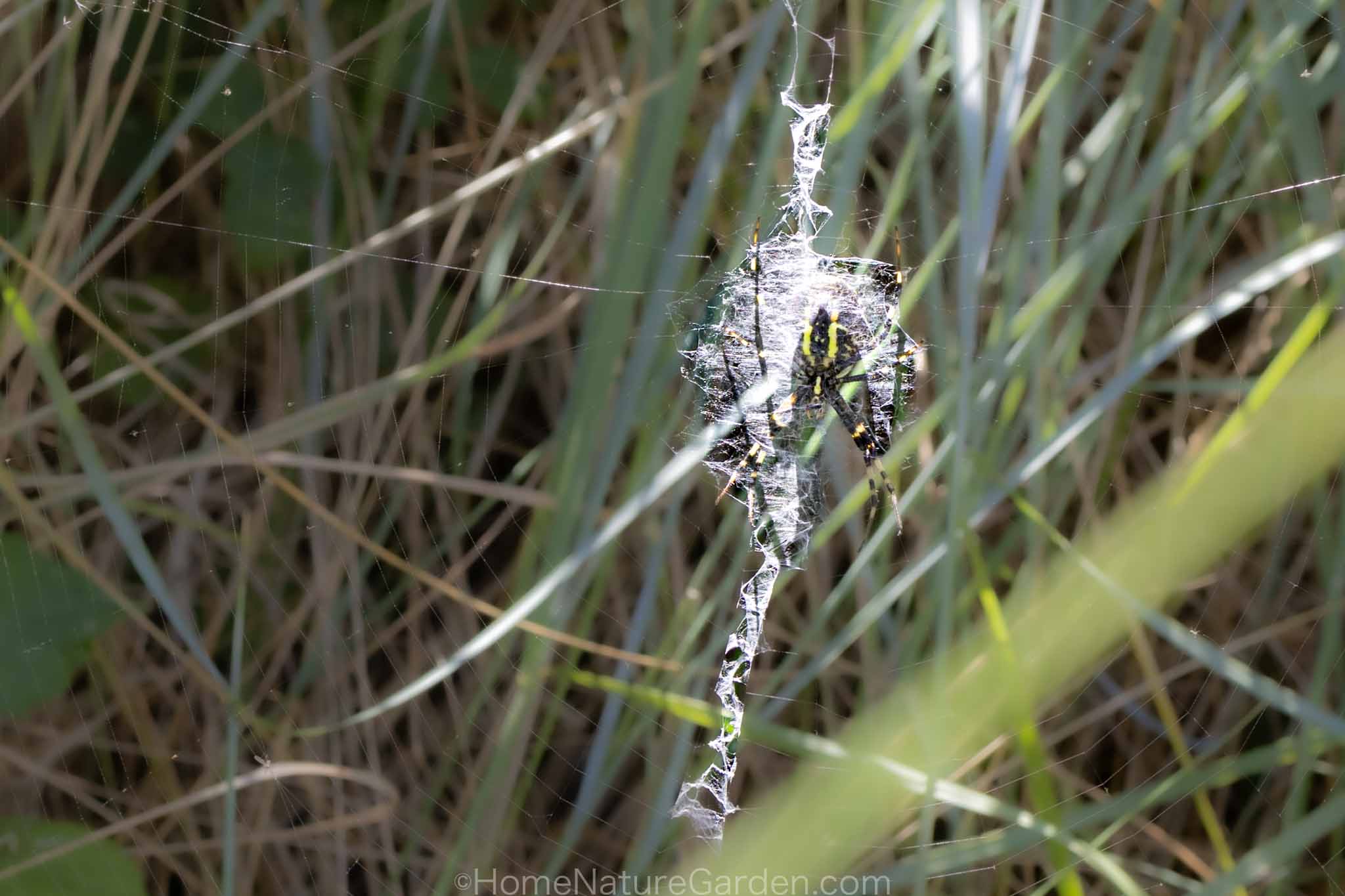
Some wasp spiders construct a zigzag line which is called a stabilimentum. This is a denser line of silk thread, which runs down through the centre of the web, and down, in a zigzag shape.
Why is it Called a Wasp Spider?
The wasp spider takes it’s name from the yellow, black and white stripes on the female’s abdomen. Initially, these appear to be the warning colours of a wasp. It is thought these discourage predators, however, the exact purpose of the striking bands of colour is still open to scientific debate.
Where Do Wasp Spiders Live?
Wasp spiders weave their webs in long grasses, in damp areas or near water, in unmanaged meadows, road verges and wildlife gardens.
The two female wasp spiders in my garden have constructed their orb webs in the long grasses, in the wilder section at the bottom of the garden. The grasses are in front of some dense blackberry bushes. The bushes are very popular with many insects. Many bumblebees, butterflies and hoverflies visit the bushes.
The grass is not damp nor is it near water. Both webs are in a sunny position, surrounded with tall grasses to which spiders could attach their webs. The presence of two female wasp spiders suggests that this area of long grass was a suitable habitat for the spiders.
Why are More Wasp Spiders Appearing in Britain?
The wasp spider is a new addition to the UK spider population. Its range has gown from the twentieth century onwards. The wasp spider is now widespread in south-east England and along the south coast, with sightings as far north as the East Midlands. The spread northwards is continuing. This pattern of expansion has also occurred across northern Europe.
According to scientific studies there is an association between warmer weather and the wasp spiders’ expansion north. It may not be that climate change is the reason for their expansion, however they do like to create their webs in a sunny position.
Suitable habitat is also a factor in their expansion. They need open, sunny areas of long grasses and strong stems to attach their orb webs and availability of insects moving through the grass.
Wasp Spiders conservation and habitat
There does not seem to be a conservation concern attached to wasp spiders, since they are listed as ‘least concern’ and their area of distribution is expanding.
However, habitat management is an important factor for wasp spiders. If grass is kept short, rather than long, it will be unsuitable for supporting the web, providing hunting space, and attracting sufficient insect prey. In UK gardens, the wasp spider can be supported by the creation of the right conditions in which a range of insects and predators can thrive together.
Wildflower planting for butterflies and bees can also increase the variety of insects using a garden, thereby helping to support the food web in the garden. Supporting caterpillars and other insect larvae is also part of the wilder food web. Allowing some plants to be eaten provides food for developing insects, which then become part of the whole garden ecosystem. You can read more about plant foods for caterpillars in UK gardens.
Why Does the Web Have a Zigzag Pattern?
An interesting feature of the wasp spider’s web is the zigzag band of silk, referred to as the stabilmentum, which runs vertically through the centre of the web.
Research has suggested the spider uses ultraviolet (UV) to make their stabilimentum. It was found that this UV feature attracted more prey to the web, than webs without it. The prey were mostly insect pollinators who are UV sensitive.
Other researchers have suggested that this feature makes the web more visible to larger animals, or it is for camouflage, or it stabilises the central part of the web. However, scientists are still unsure of the exact reason for the stabilimentum.
On my first few visits to the two female wasp spiders in my garden, there was no stabilimentum in either web. When I returned on another occasion one of the spiders had constructed a new web with a stabilimentum. This showed that wasp spiders do not always add the zigzag line to their web, when they are constructing it. The zigzag was easy to see in the web. It was not a perfect zigzag shape, instead it was irregular dense line of white silk running vertically through the web.
What Do Wasp Spiders Eat?
Wasp spiders eat a range of insects that become caught in their web. These include:
Grasshoppers
Wasps
Flies
Hoverflies
Bees
When I first found the two wasp spiders in my garden, neither web had prey. When I returned the next day, one web had prey. It was wrapped in silk. Yellow markings showed through the silk, and may have belonged to a hoverfly. However, most of the insect was concealed, making it difficult to identify the prey with certainty. If you would like to learn more about the role hoverflies play in UK gardens, read my article on hoverflies and the hidden ecology of the British garden.
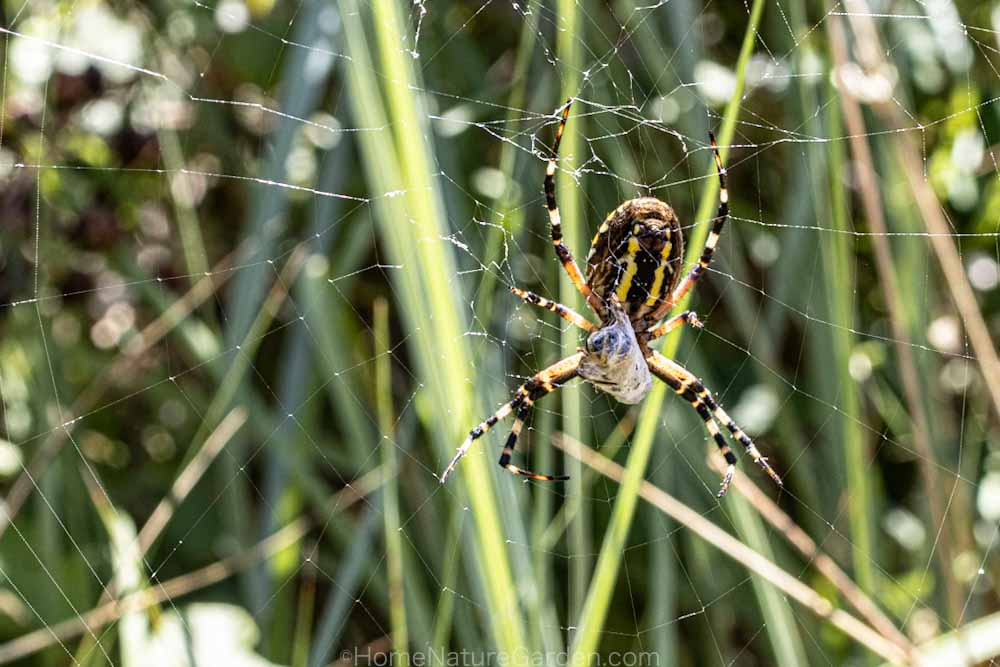
The second spider had also caught prey in her web, but that was much smaller and too heavily wrapped in silk, to identify.
Are Wasp Spiders Dangerous?
Despite their distinctive bold appearance, wasp spiders are not thought to be dangerous to people. Similarly, to many spiders, the wasp spider injects a toxin into its prey to subdue it.
Wasp spiders almost never bite. They only bite in self-defence. The female may use its fangs to bite human skin when it is roughly handled or accidentally trapped. But the amount of venom delivered is very low, and it is a considered mild. The bite has been described as similar to a wasp or bee sting. Consequently, when encountering a wasp spider in a garden, it is best to let it be.
The wasp spider is generally shy. It prefers to flee when disturbed, or vibrate its web. The vibration is thought to be a defensive response, making the spider harder for a predator to attack or locate.
The Life Cycle of a Wasp Spider
The life cycle of the wasp spider lasts about a year.
Spiderlings
The young wasp spiders develop within a protective silk, egg sac. They remain over winter before emerging as small spiderlings between early summer and late autumn. The spiderlings pass through several moults as they increase in size.
Adults
Females and males both become adults during the summer months. Females are easily seen hanging in their webs from July onwards. Males develop into small spiders and tend to have a short period of adult life.
Mating
Mating can be a dangerous activity for the male. He waits for the female at the edge of the female’s web, until after she has her final moult. Then he takes advantage of her soft jaws and rushes in to mate. If he is lucky he escapes the web, however, many males get eaten by the female at this time.
Females
Adult female wasp spiders survive long enough to mate and lay eggs. She lays her eggs in a silk sac, attached on grasses near to her web in early autumn.
Egg sac
After mating, the female lays her eggs in an egg sack and these remain in the silk sac over winter.
Autumn
The wasp spider mating season occurs during autumn. The male becomes more active during this time to find a mate.
Winter
The eggs overwinter in the silk sac. They emerge as spiderlings during early summer to late autumn.
Wasp Spiders in My Wildlife Garden
I noticed an unusual spider in the long grass, in the wilder section, at the bottom of my garden. The spider I saw had an elongated shape web, precariously attached to tall blades of grass, blowing about in the wind. It may have started off round but got broken down by the wind. There was no prey in the web.
The spider had a yellow abdomen, with black stripes of differing thickness. When I researched it, I found that it was a wasp spider. These spiders create a round orb web. Initially, I wasn’t sure which way round the spider was. My spider book showed it was a female.
When I looked nearby, I found another female. It was not as big as the other female. It had pieces of dandelion fluff stuck on its web. No prey either. I couldn’t see a male anywhere in the surrounding grasses. The male is quite drab in comparison. He has no stripes, but his abdomen is pale brown with two light brown bands to the sides. His legs are light brown.
When I first found the wasp spiders I could not see a stabilimentum in either web. As noted, when I returned the next time, one of the females had constructed a thick white band of zigzag silk, through the centre of her web. It was easy to see in the web. It was not a perfect zigzag, it was irregular in places but it still ran vertically through the web.
How Wildlife Gardens Help Wasp Spiders
Wildlife gardens, or wilder areas in gardens can help wasp spiders.
Wild areas
The two wasp spiders in my garden are in the wilder area with long grasses, at the base of the garden. There are blackberry bushes behind the long grasses which attracts native insects. Leaving areas of long grasses is one way of creating a wildlife friendly garden, where food, water, space and shelter allow different species to thrive.
Avoid pesticides
It is helpful to avoid pesticides that are harmful to all insects.
FAQs About Wasp Spiders
Why is it called a wasp spider?
The wasp spider’s name reflects the colours of the female’s abdomen, which is black, yellow and white. These colours are the warning colours of a wasp.
Are wasp spiders poisonous?
Wasp spiders are not poisonous. They have venom to subdue their prey. They are not regarded as dangerous to humans.
Can wasp spiders bite?
Yes, wasp spiders can bite, but this is unusual and only occurs if the spider is roughly handled or trapped. They are not aggressive towards people.
Why do wasp spiders have yellow stripes?
The female’s yellow stripes give her an appearance of a wasp. Theses stripes discourage predators from approaching her. However, the exact reason for the yellow bands is not fully understood.
What is the zigzag in the web?
The thickly woven zigzag band through the centre of the web is calleda stabilimentum. Researchers have suggested several reasons for the zigzag band, however the precise reason is unknown.
Are wasp spiders rare?
They were uncommon in Britain, but their range has increased in recent years. However, they are now common in southern England and along the south coast. Their range is gradually extending north.
What month are wasp spiders most active?
Adult female wasp spiders are highly visible during July and August, when their distinctive webs and large size are easier to see.
Where do wasp spiders lay eggs?
Female wasp spiders lay their eggs in a silk sac attached to vegetation, usually in their grassland habitat.
Should I remove a wasp spider?
There is no reason to move a wasp spider. Wasp spiders are not dangerous, and are an important part of the garden’s predator population. If the spider has selected an area of long grass for it’s habitat, it is best to leave the spider undisturbed in it’s web.
Conclusion
The wasp spider has adapted to the changing climate and once rare, is now more common. Finding two females in my garden in an area of long grass, set up in their webs made me realise it is a beautiful spider, with interesting colouring. The more visits I made to their habitat, the more interested I became in the structure of their webs, the insects caught in their webs, the difference in the sizes between the males and females, and the different stages of their life cycle.
Good Books About Spiders
Chinery M. 1993. Spiders. This is an older guide from my own collection and one I still find useful.
Affiliate disclosure: This post contains affiliate links. If you make a purchase through one of these links, I may earn a small commission at no extra cost to you. As an Amazon Associate I earn from qualifying purchases.
Jones-Walter’s L. M. 1989. Keys to the Families of British Spiders.
View the book on Amazon.
Bee L. Oxford G. and Smith H. 2020. Britain’s Spiders. A field Guide.
Shows where spiders are likely to be found and on what months of the year. It provides the spider’s distribution, habitat and description.
Bee L. 2016. A Guide to House and Garden Spiders.
Useful card identification guide, with forty detailed images. Types of web, habitat, distinctive featured and web/prey structure. I own this guide myself and have found it an excellent reference that is quick and easy to use.
Essential website for further information:
The British Arachnological Society
Leave a Reply