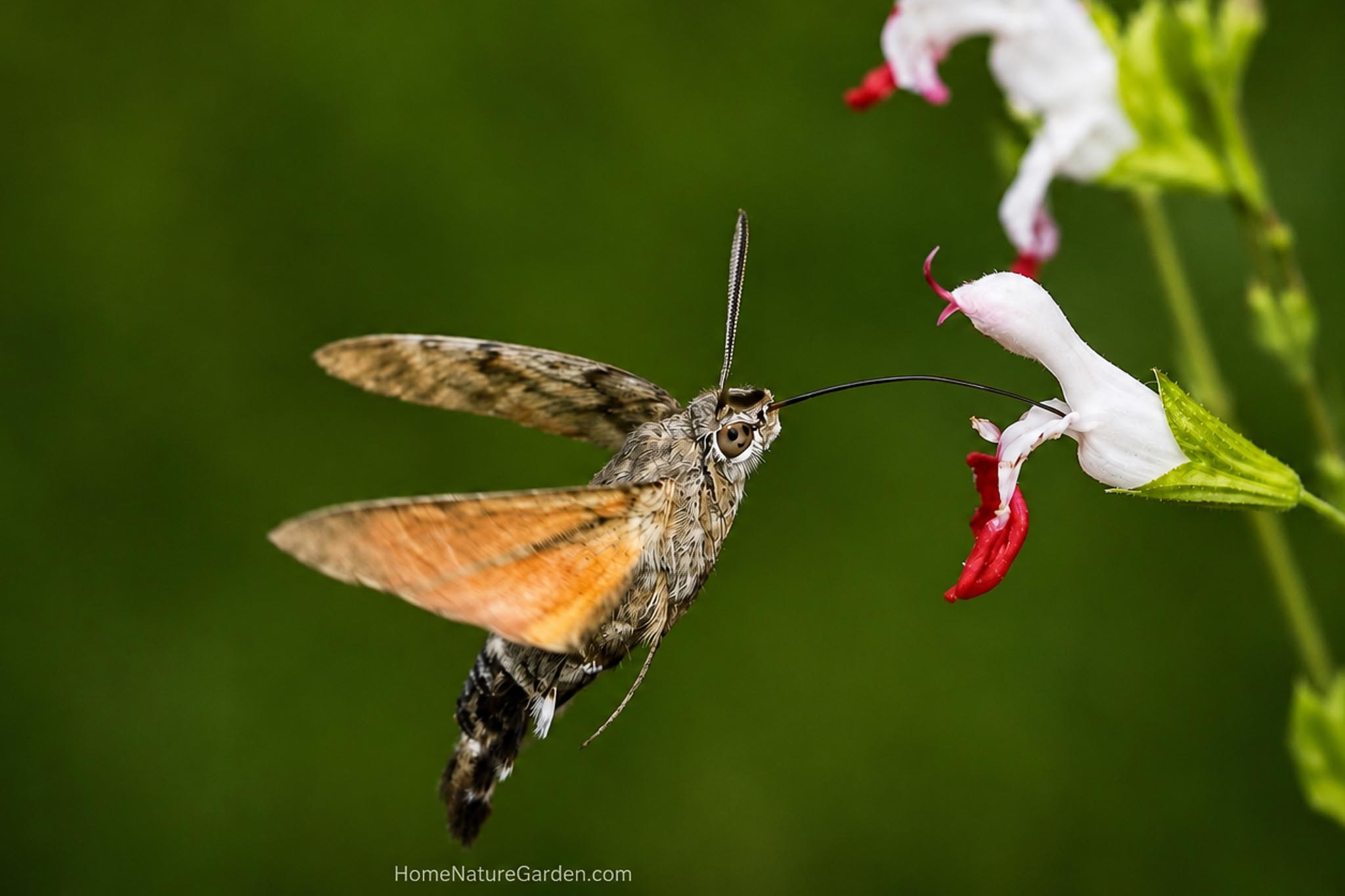
Have You Seen a Tiny Hummingbird in Your Garden?
Very often I hear a hummingbird hawk moth before I see it. It whizzes past making a low humming noise, hovers in one place in front of a flower, and sticks a long proboscis into the flower. Milliseconds later, it has flown on to another flower, or away over the garden fence. It wasn’t a bee, wasp or hoverfly. It was a moth. In flight, they bear an incredible resemblance a tiny humming-bird.
Rather conveniently, a Humming-bird hawk-moth arrived in the kitchen while I was working on my laptop, on a wildlife garden article. Of course, I had to abandon the article for a few moments while I let it out through the roof window. Interestingly, it was followed out by a wasp.
Having had such a close encounter, I had little choice when deciding what to write next. It had to be about the humming-bird hawk-moth. A little research revealed that something very interesting is happening: the UK is currently experiencing a large influx of these amazing migrant moths.
Why have so many had turned up here, where they have come from, and what are they actually doing in our gardens?
What Is a Humming-bird Hawk-moth?
A humming-bird hawk-moth (Macroglossum stellatarum), is a day-flying hawk-moth with a wingspan of roughly 50–58 mm. Its grey-brown forewings aren’t especially flamboyant. When in flight there are striking flashes of orange from the hindwings, together with a distinctive black-and-white abdomen. If you manage to get fairly close you can see the moth’s remarkable brown eyes. It has a wingspan of 50-58mm and makes about 80 wingbeats per second according to Butterfly Conservation.
Why Does It Look Like a Hummingbird?
The moth looks like a humming-bird because it hovers, has extremely rapid wingbeats and a similarly long proboscis. Butterfly Conservation has suggested that the moth uses an amazing 80 wingbeats per second.
Is It Really a Moth?
It is often thought moths only come out at night. However, this moth flies in daylight, often feeding in the early evening, on warm days. It can even continue feeding during rain showers.
Why Are There So Many Humming-bird Hawk-moths in the UK in 2026?
These moths are migrant species and when the conditions are favorable large influxes arrive in the UK from continental Europe. Both the southerly airflow and hot summer have been linked to this year’s large number of sightings.
Butterfly Conservation reports that some years bring in large influxes from the continent. They are specifically asking people to record migrant months in 2026 because researchers are interested in migration, breeding and overwintering as the climate changes.
Where Do Humming-bird Hawk-moths Come From?
Humming-bird hawk-moths may look delicate and fragile as they hover over a flower, but appearances are rather deceptive. Humming-bird Hawk-moths reaching Britain are migrants from North Africa and Southern Europe.
One minute, these delicate, fragile creatures, are carefully drinking from your coneflowers, the next, you find that their species is capable of remarkable long-distance migration. As an illustration, a journey from London to Marrakesh is roughly 1,430 miles or 2,300km, although of course, not every humming-bird hawk-moth arriving here has flown all the way from North Africa.
Perhaps my humming-bird moth was thinking, “I’m stuck in a kitchen, but that’s nothing compared with the journey I’ve had to get here.”
Are Humming-bird Hawk-moths Becoming Resident in Britain?
These hawk moths are commonly migrants, but they have bred in Britain. Butterfly Conservation has reported that some humming-bird Hawk-moths have successfully overwintered in some sheltered areas and locations with mild weather. Their 2026 guidance says milder winters may enable some offspring to survive.
Scientists have considered whether changing climate conditions are permitting these migrant species to successfully breed and overwinter here. Breeding success isn’t dependent upon nectar rich flowers. Adults need nectar, but successful reproduction also depends on appropriate larval food plants and suitable conditions.
What Flowers Do Humming-bird Hawk-moths Feed On?
These moths have a long proboscis, or tongue that unfurls and enables them to hover near to tubular flowers such as red valerian and honeysuckle, and drink nectar deep within the flower. They also visit other nectar-rich plants including buddleia, phlox and coneflowers. Butterfly conservation recommends that wildlife gardeners plant nectar-rich producing flowers for the adult moth to drink from across the summer and autumn seasons.
Feeding an adult moth isn’t the same as providing a habitat for the moth’s whole life cycle. The adult female needs different plants on which to lay her eggs, and these same plants provide food plants
for the caterpillars. I turn to those plants next.
What Do Humming-bird Hawk-moth Caterpillars Eat?
The humming-bird hawk-moth lays its eggs on plants that later become the food for its caterpillars. Lady’s bedstraw (Galium verum) produces masses of frothy, tiny yellow flowers. Hedge bedstraw (Galium mollugo) has clusters of white flowers, and the typical sprawling, spreading bedstraw form. Wild Madder (Rubia peregrina) is an evergreen scrambling, spreading plant with glossy leaves and inconspicuous greenish flowers. Finally, Red Valerian (Centranthus ruler) can be grown ornamentally in the garden, unlike wild madder or hedge bedstraw. This plant is especially important for the humming-bird hawk-moth because it provides nectar for the adult moth and may be used as a larval foodplant by its caterpillars.
These are not the sorts of flowers you may wish to deliberately plant in your garden. They may be considered as slightly unruly plants when growing in the garden. These plants are often found on grass verges, along hedgerows, woodland edges, or round the wilder edge of parks, or possibly in the wilder parts of your own garden.
It is always a good idea to check the wild flowers growing in the wilder areas in your garden, before you cut them back or pull them up. What might look like an uninteresting weed to us, might be a significant food plant for a caterpillar.
Wildlife gardening is not simply about the plants we plant; it is also about recognising the importance of the plants that arrive by themselves. I tend to notice nectar-producing flowers more than these sorts of food plants.
What Does a Humming-bird Hawk-moth Caterpillar Look Like?
The caterpillar is extremely different to the adult humming-bird hawk-moth. It is large, green and striped, with a a characteristic projection or horn at the rear, common in many hawk-moth caterpillars. If you happen to have bedstraw in a wild section of your garden, you might suddenly remember that you’ve seen one of these caterpillars. August is a particularly good month for looking out for caterpillars.
Butterfly Conservation has photographs of the distinctive caterpillar here.
The Humming-bird Hawk moth Life Cycle
Adult – Egg on food plant – Caterpillar – Pupa – Adult.
The fully grown caterpillar makes its caterpillar near to the ground among leaf litter, leaves of the food plant or soil. Butterfly Conservation have reported that eggs usually hatch after about one to two weeks. Caterpillars develop in about a month. Pupation takes roughly three weeks. Although these are approximate timings.
How Can I Attract Humming-bird Hawk-moths to My Garden
Wildlife gardeners can make their gardens highly useful for these moths. A variety of nectar-rich flowers throughout the summer and autumn provides an important source of food. They are attracted to deep or tubular flowers so they can take advantage of the nectar deep within the flower, with their long proboscis. They also visit non-tubular plants such as buddleia and salvia, as in the image above.
Caterpillar food plants such as bedstraw can be allowed to grow, or be deliberately introduced in wilder areas of the garden. Butterfly Conservation stresses the importance of both nectar plants for adults and food plants for caterpillars.
Do Humming-bird Hawk-moths Pollinate Flowers?
Nectar-feeding humming-bird hawk-moths can transfer pollen while visiting flowers, similarly to bees, wasps and hoverflies and therefore contribute to pollination. Butterfly Conservation has described moths carrying pollen between flowers while feeding on nectar. Pollination doesn’t stop when the familiar bees and hoverflies leave the flowers. Moths are another part of the network of insects moving pollen through the garden. Interestingly, moths tend to be an overlooked aspect of garden pollination. Very often we think of bees when somebody mentions pollinators. Also hoverflies pollinate flowers.
Are Humming-Bird Hawk-moths Rare in the UK?
These moths are not rare, but seeing one still feels like a special treat. They migrate here regularly and can be seen across the whole UK, but their numbers vary considerably from year to year. Some years produce large influxes.
When is the Best Time to See a Humming-bird Hawk-moth?
Generally they can be seen anytime between May and September, however, they can occur outside the usual summer flight period.
Some people assume the moth has to be observed during night time hours because its a moth. However, this is a day flying moth that drinks from nectar producing flowers in the daytime. There is no need to wander round in the darkness searching for a humming moth over your flowerbeds.
What Should I Do If I See One?
Watch it and photograph it if you’re quick enough. I have many, many photographs of this moth that are not up to scratch! It is an annual challenge! Don’t catch it. Record it. Butterfly Conservation specifically asks people to submit Humming-bird Hawk-moth sightings to the National Moth Recording Scheme, since records help scientists understand changes in migration, breeding and overwintering.
I took the original photograph of the Humming-bird Hawk-moth feeding from a salvia myself. As it wasn’t quite tack sharp, I used AI to enhance the image for this website.
Humming-bird Hawk-moths and Our Changing Gardens
A spectacular migrant arriving in a British garden tells us something important about how interconnected our gardens are. The humming-bird hawk-moth at your coneflower may have flown across from continental Europe. Its caterpillars could then be living without you knowing, on a bedstraw. The changing climate could alter whether future generations of this amazing moth simply visit or manage to breed and reside here.
Affiliate disclosure: This article contains affiliate links. If you make a purchase through one of these links, I may receive a small commission at no additional cost to you.
Recommended Books About British Moths
Hawk-Moths of the British Isles
This is a handy identification guide for anyone wanting to learn specifically about British Hawk-moths in their garden.
Available from Amazon
Concise Guide to the Moths of Great Britain and Ireland
An accessible identification guide book for learning about moths found in the British or Irish garden.
Available on Amazon
FAQs For Hummingbird Hawk-Moths in UK Gardens
Are Humming-bird Hawk-moths rare in Britain?
No. They are not rare, but their appearance and distribution differs from year to year.
Do Humming-bird Hawk-moths bite or sting?
No, they do not bite or sting people. They are simply equipped to drink nectar with their long proboscis. They uncurl it to drink and then coil it back up when they’ve finished.
What do Humming-bird Hawk-moths eat?
These moths drink nectar from nectar producing plants such as buddleia and coneflowers.
Where do Humming-bird Hawk-moths go in winter?
Many migrate south across to warmer parts of Europe. Some overwinter in the UK, particularly in areas where the weather is mild. Researchers are particularly interested in their overwintering patterns in responses to changes in climate.
Can Humming-bird Hawk-moths breed in UK gardens?
Yes. Humming-bird Hawk-moths can breed in Britain, including in gardens where suitable caterpillar foodplants are available. Females lay their eggs on plants such as bedstraws, which then provide food for the developing caterpillars. Providing nectar for the adults is helpful, but supporting the complete life cycle also means making room for their less noticeable foodplants.
What attracts Humming-bird Hawk-moths to a Garden?
It is attracted to nectar-rich flowers, particularly heavily scented deep tubular blooms. It appreciates a long flowering season; suitable caterpillar food plants and a pesticide free garden, with wilder areas.
Leave a Reply