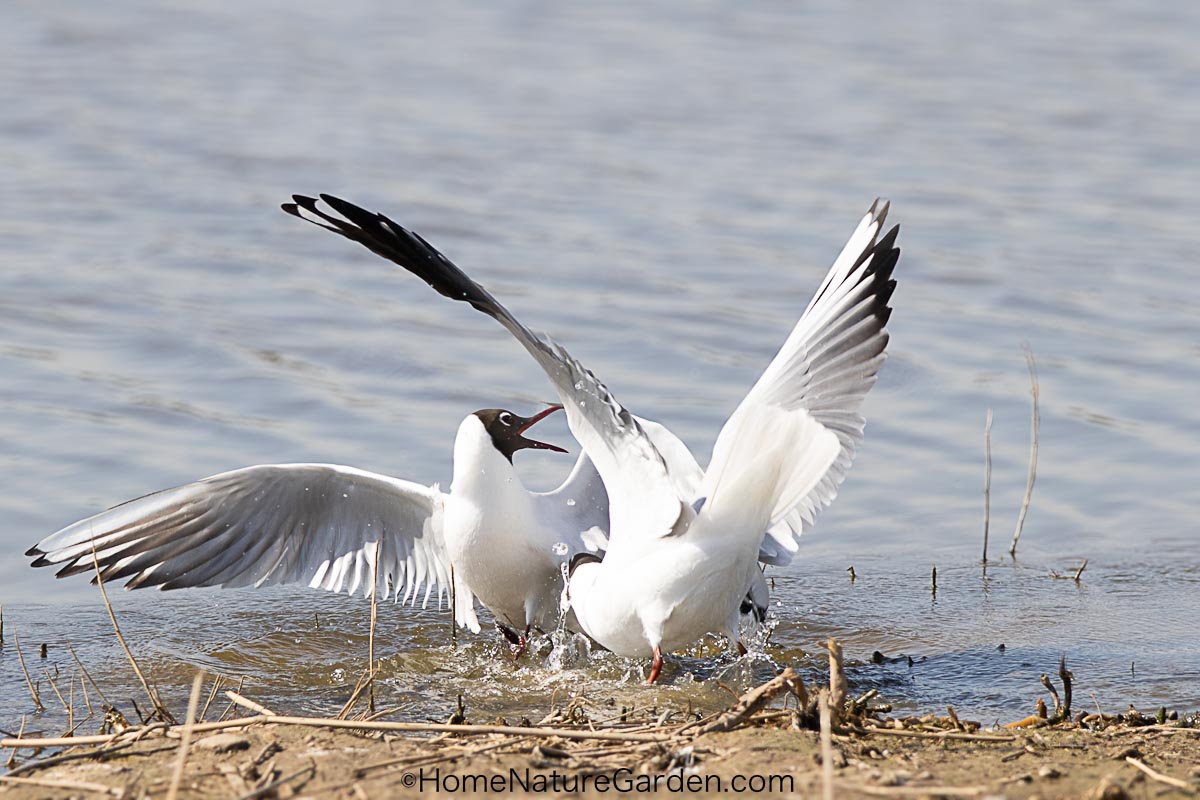
During walks along the river bank I have started to notice bird behaviour. The way waders interact when they are together, particularly the swans and black-headed gulls. Behaviour and interactions observed through the camera lens inspired this article.
Remaining Close
I heard a swan calling and wondered why. It came round the bend in the river, and approached another swan. The sunlight reflected across the river. They were extremely close, one body next to the other. Their behaviour seemed more than toleration, as they did not push or chase the other away. It seemed like they cared. Their movements were coordinated and they moved together. It felt like they had a connection or closeness between them.
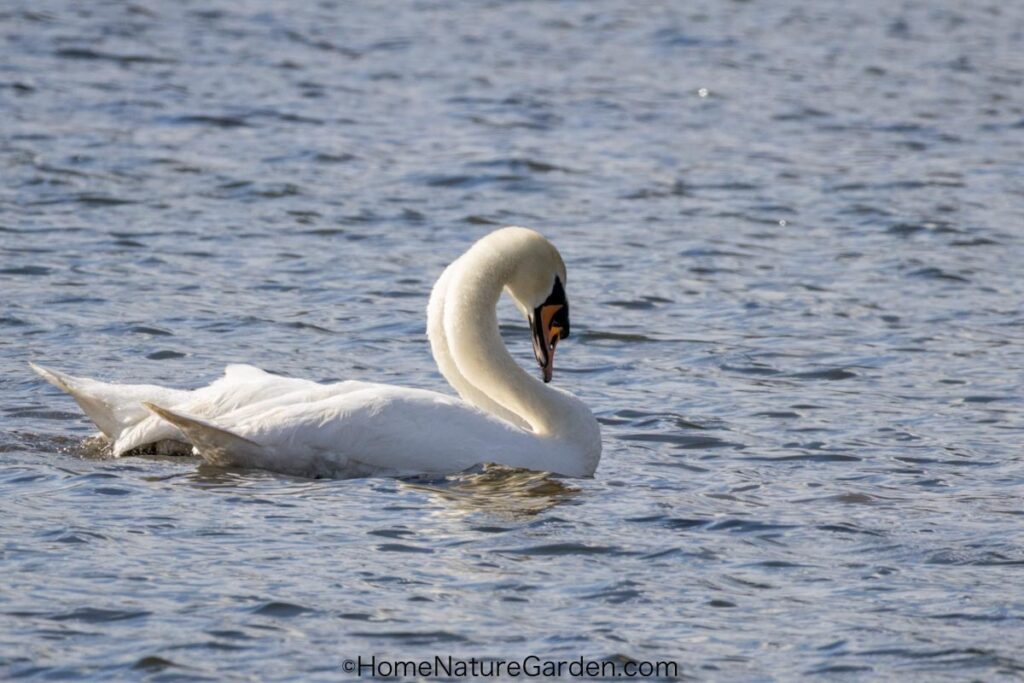
The two swans then turned and faced each other, their beaks touching. This movement became a beautiful image of the two swans as a heart shape. These subtle posture movements and mirroring behaviour may have been part of a mating display, or an early bond. I was uncertain because a bonded pair had their nest on the same section of the river. The male from that partnership kept this section of the river clear of other swans. Whatever, the reason their movements felt coordinated, calm and connected.
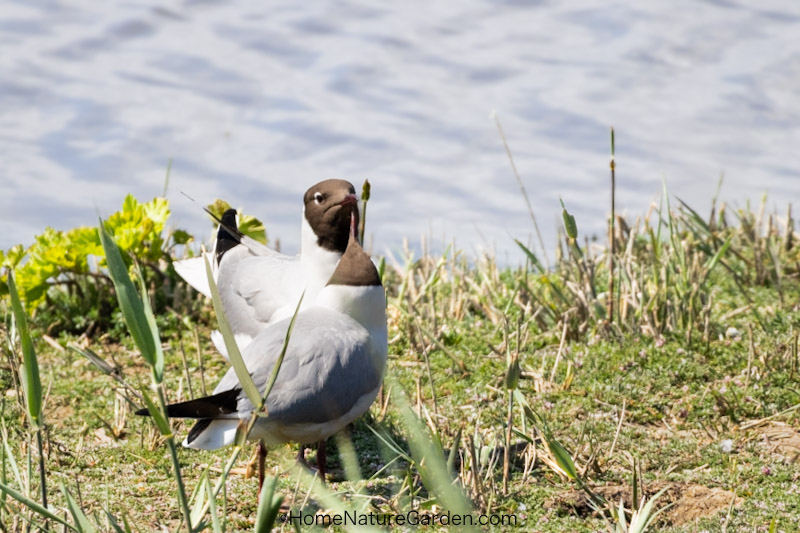
Further down the river, on a dry stretch of land, with hardened, cracked mud and tussocks of grass, two black-headed gulls stood together. I saw one gently push its beak into the feathers of the other gull’s neck. Not very deeply. It didn’t seem aggressive or threatening. The second gull stayed close and calm.
Gentle and Calm Behaviour
Their behaviour seemed peaceful. There was no alarm or conflict. It felt like companionship and a connection between them. It might have been bonding, mating display or a combination of both. A sense of emotion or a display of care seemed to underlie the behaviour, but it wasn’t random behaviour. Black-headed gulls are sometimes thought of as noisy birds, especially when they are competing for food. Peaceful moments like this may alter how these birds are perceived. I saw social bird behaviour that was gentle and calm.
After the intrusion, I watched one of the black-headed gulls collecting twigs, from dry, hollow looking stems, emerging from cracked mud, at the river edge. Then, it repeatedly carried the twigs across the water, to the other gull. It appeared to be purposeful or thoughtful bird behaviour, to prepare a nest. Perhaps another part of the connection between the gulls.
Separate Watchfulness
Back up the river, I saw a female swan sitting on a nest, on the same section of the river, as the other two swans but some distance away. The nest had been constructed on a raised mud bank on the opposite side of the river, surrounded by wild grasses. The large area behind the bank, more or less the size of a field had mud flats, and islands of greenery which backed onto grassy woodland. It was frequently visited by herds of grazing deer.
The remnants of a fence was visible here and there along the length of the bank. Many sections of the bank had no fence. The gaps in the fence appeared to suit the two swans and a couple of pairs of Canada geese who had also built nests there, some distance apart amongst the foliage. The connection between the pairs of geese was restricted to themselves. Any movement towards a pair by another Canada goose resulted in loud honking.
Nesting Bird Behaviour
When I walked back past the nest, opposite I saw the female swan, washing in the river and eating, her beak submerged beneath the water. I wondered how she was going to get back across the mud leading up to the bank. She would get muddy if she walked across the mud. With her wings outstretched, she ran a few steps, wings moving rapidly, lifting herself up and flew to the top of the bank, next to her nest. She was clean when she settled down, having not gone far for feeding and washing. Her movements seemed purposeful towards the nest and suggested a connection to her future offspring. This nesting behaviour was likely instinct, but it also suggested a connection to her responsibilities of protection and nesting.
Apart but Still Connected
There is a distance, or separation between the swans when one bird is on the nest. I watched as the male slowly passed the nest site, his head turned towards it. The female looked up momentarily, before tucking her beak beneath feathers on her back. That felt like a connection between them, even though the male was mostly absent, sometimes nearby, or further up the river. He appeared watchful and alert, and determined to maintain their territory. This seemed to be a less obvious form of connection between the pair. They were not always together. Perhaps the look was a strengthening of the connection between them, despite the absence.
Territorial Tension
On another walk, the male swan flew past me, down the river, towards the bend further on and landed, near a group of six or seven swans. He raised his wings in an arc, over his body, holding his neck and head high up. The other swans moved along rapidly, on the water. The male chased a swan until the bird finally lifted into flight. He flew low behind it, his beak close to its webbed feet.
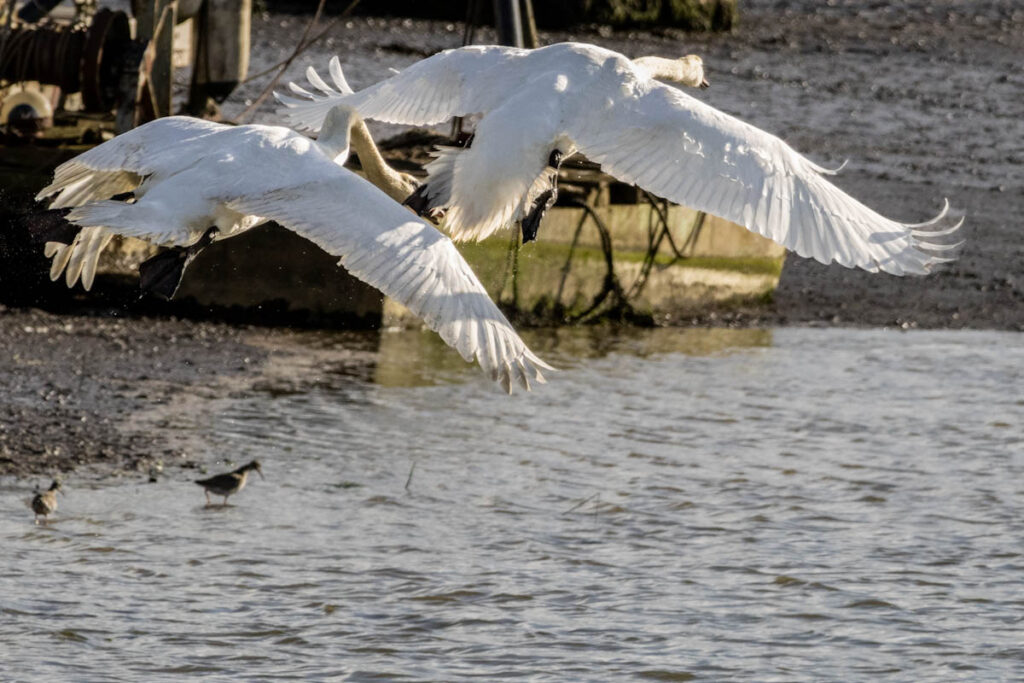
Eventually the swan being chased, climbed higher into the air and flew off down the river. This seemed to be an example of territorial bird behaviour. The male appeared determined to keep a stretch of the river clear of other swans, through aggressive behaviour, possibly to protect food resources, nesting space, or the bond or connection with his partner and future cygnets. Territorial behaviour can also be seen among smaller gardens birds, particularly robins during winter.
I walked down to where I could see the two black-headed gulls. I saw one of the gulls, possibly the male respond rapidly to another gull attempting to land nearby. The intrusion seemed unwelcome and the reaction was instant, with strong defensive behaviour replacing the calm behaviour seen before. Black-headed gulls can become more territorial during the breeding season. Like the swan, the gull was probably defending territory and food sources, while also protecting the close connection with its his partner.
On Reflection
Watching these interactions along the river, suggests that black-headed gulls and swans have more complex relationships than is sometimes assumed. Closeness can suddenly change into territorial defence when one or more birds are too close. The same pair of birds that seem calm and close together can change their behaviour instantly, to defend and protect. That bird behaviour does not break the connection between them, it feels like a part of the connection.
An alternative version of this article will be published in a forthcoming edition of the River Deben Association Magazine.
Responses
Lovely. Thank you.
Thank you very much.