How Habitat Structure, Food Supply and Vertical Layering Determine How Many Robins a Garden Can Support
In my rural garden, two robins hold separate territories within a space
of just 25 x 16 metres. Their presence is not accidental. It is shaped by the structure of the garden itself, by layered planting, varied heights and the distribution of food resources. Garden design determines if robins visit, and whether they can establish and defend territory.
The dominant robin holds a territory in the central area of the garden. A trellis fence serves as a lookout post and boundary marker. The robin watches over the lawn, a bed of plants selected for nectar production over many months, a separate wildflower area with mixed native species and grasses, a pond and a bird feeding station – the feeding area is something I’ll explore in a separate article. The trellis is interwoven with ivy, honeysuckle and clematis; creating a dense cover, particularly in the summer.
The trellis was intentionally placed to separate the main garden from the wildlife friendly section. That area contains raised nettle beds, compost bins and a mixed wildlife hedge across the boundary of the garden. These varied habitats, with different heights and levels provide multiple foraging opportunities. The structural diversity makes the garden attractive to robins.
How Many Robins Can a Garden Support
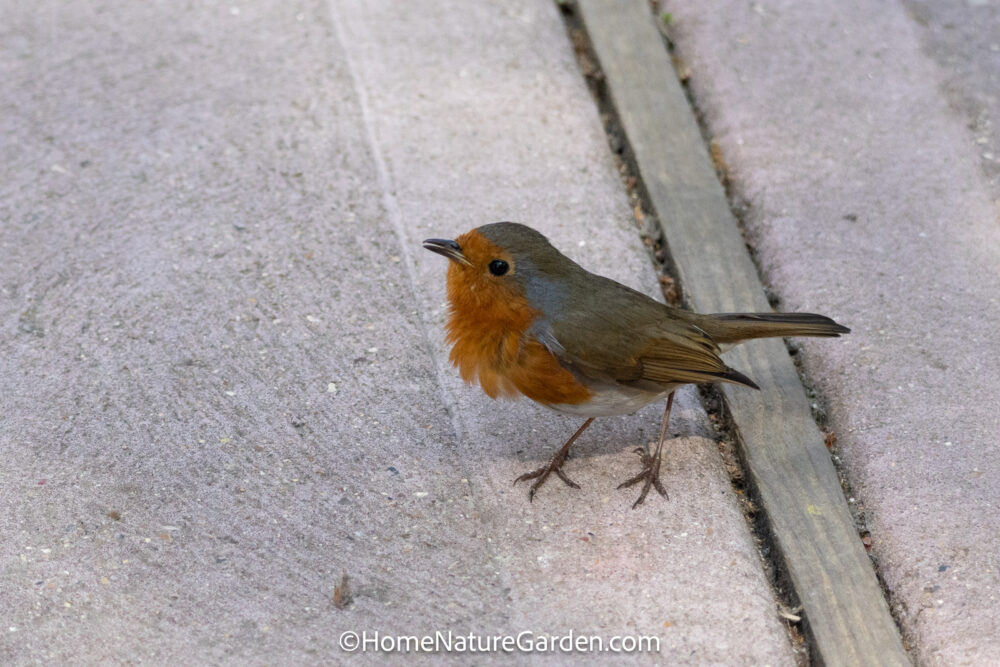
When considering how to attract robins, a more useful question may be how many territories a garden can sustain. The two robins in the garden here, do not coexist peacefully. Robins are highly territorial and determined defenders of their food supply. When the dominant robin in the garden approaches the other bird, in the wildlife section it flies into the next garden. It never enters the main garden area. This pattern represents classic European robin territorial behaviour.
My medium-sized garden measures approximately 25 × 16 meters and two robins each have a territory. The dominant bird holds the most food resources. Open lawn for worms, structured perches for lookout and singing, pond edges with insects and the area with bird feeders. The other robin occupies a habitat with little foraging ground, a hedge base with thick low cover, compost area and nettle beds. It has little opportunity to approach the bird feeders.
A larger garden might support more robins to claim and defend territory, but only if there are essential structural features that a robin requires.
Structural Requirements for Robin Territory
Robins require trees, bushes, fences, or posts that function as lookout structures, and perches for display and singing. They also require a dense refuge within a short flight distance. Territory size is not simply about a space, but more about the quality of the habitat. A mixture of feeding areas with vertical features is more valuable than only a long lawn.
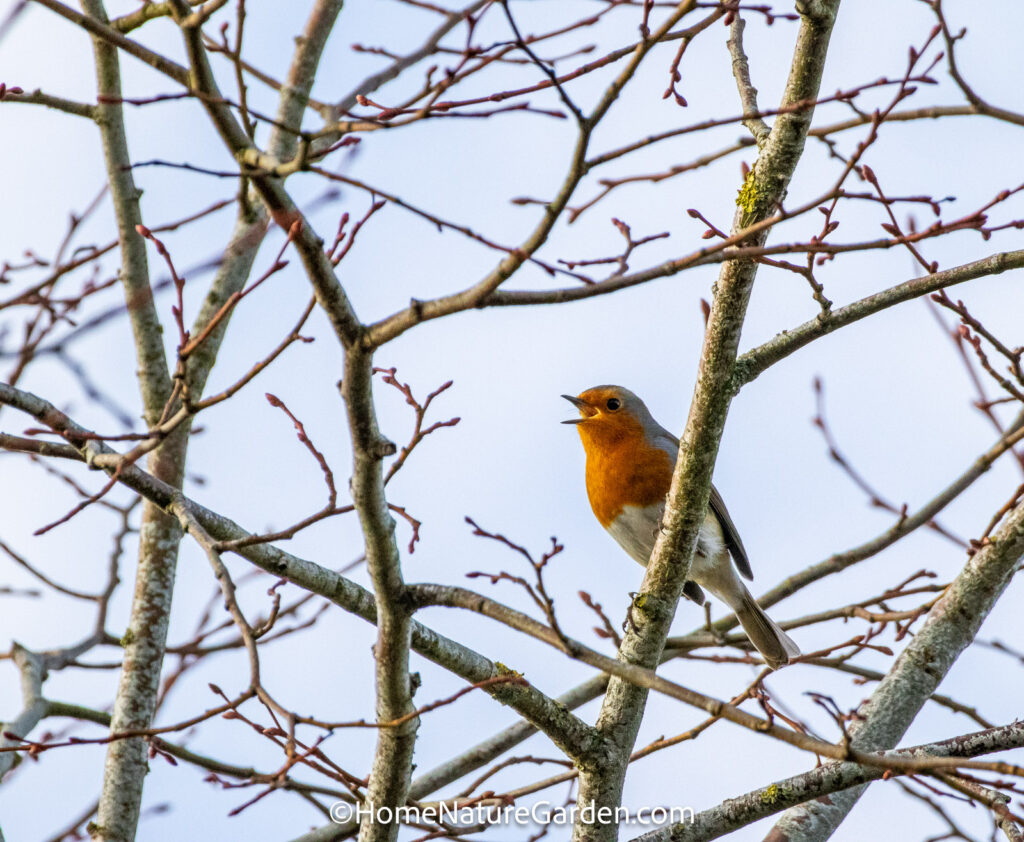
The trellis fence in this garden is more than a dividing fence. It is an ecological structure and a habitat. Birds use it as a perch and invertebrates reside there. The climbing plants intertwined through the fence have enabled the trellis to become an ecological structure. Ivy provides late nectar and winter cover. Honeysuckle provides dense nesting structure. Clematis add extra layers to the structure in the spring and summer. These plants collectively provide thickness at different heights on the trellis. This is essential for a robin that forages low and sings from medium level perches.
The wildlife section has a different role in the ecology of the garden. Raised nettle beds support aphids and caterpillars, which then feed insectivorous birds. The compost bins generate decomposition and heat, which attract larvae, flies and beetles. The mixed wildlife hedge provides low density cover for refuge. The hedge also functions as a store for invertebrate populations.
If these features were reduced, the garden might not support two robins. If the hedge was trimmed and thinned, or the nettles were removed, the garden might not support two territories.
Territorial conflict itself functions as an ecological regulator. It prevents robins from over exploiting limited supplies of food. It ensures each robin has access to sufficient vertebrates within a particular space. In smaller gardens, only one robin may hold a territory. In larger gardens with more structural features, several smaller territories may exist.
Robin Territory Shaped by Garden Design
Garden design for robins consists of different heights and levels. Robins do not eat in the tops of trees, unlike birds, such as chaffinches or blue tits. They use trees as perching structures for singing to survey and defend their territory. They need bushes at a low height for catching insects.
In this garden, the dominant robin catches insects on bushes, by flying up towards them. It also frequently flies down to the ground from a lower branch of a bush or tree, to catch an insect on the lawn, pathway, or rough ground. At ground level, it uses open grass for earth worms, and inspects logs for partially hidden insects. The use of features at different levels illustrates how closely behaviour is linked to garden structure.
A garden by itself does not attract robins, it is the complexity of the habitat that determines how many robins can be sustained.
Territory as Evidence of a Functioning Habitat
Attracting robins to a garden depends on creating layered habitat, not simply open space: plants at different levels, low foraging areas, a variety of places to perch at different heights, and dense cover. In my garden structure for robins, climbing plants, rough and smooth grass, compost heaps, and nettle beds together create functioning habitat.
The Royal Horticultural Society has noted that tangled up climbing plants can be a haven for birds as a nesting site. When these features are present, a robin may not only visit but establish a territory and stay. In this way, garden design determines whether robins pass through or stay to claim space.
Why Having a Robin in Your Garden Matters
If garden design determines if a robin stays, the question arises, why does it matter if they do? A resident robin represents ecological function, balance and continuity.
The robin feeds mainly on invertebrates. Within its territory, it consumes spiders, beetles, flies, earthworms, larvae, and caterpillars – the same larvae often noticed by gardeners as leaf damage. (I explore this balance between caterpillars and plant damage in Plant Foods for Caterpillars & How to Spot Leaf Damage). The robins foraging behaviour covers several different levels, hedge base, lawn, low branches, compost, and shrub.
This feeding activity contributes to the regulation of invertebrate populations. The robin does not consume insects indiscriminately, instead it operates within the limits of its territory. Territorial behaviour prevents the over-exploitation of food resources. In this way the robin participates in maintaining ecological balance in a garden framework.
A robin’s presence indicates that the structural features of its territory are functioning effectively. It has reliable food, dense refuge within short distance, vegetation at different heights, and elevated perches for surveying and singing. A garden that supports a resident robin is one that has achieved a certain degree of habitat complexity.
Garden Design for Robins is Designing for a Functioning Ecosystem
Robin friendly garden design commonly has climbing plants, leaf litter, mixed hedges, and compost heaps. These features sustain pollinators and other insectivorous birds. Designing for robins is designing for a functioning ecosystem. This approach reflects the broader principles in my Wildlife Garden Philosophy, When a Garden Becomes a Wildlife Space, where garden design is considered as an ecological process rather than decoration.
For a closer look at how robins defend territory through winter in UK gardens, see Winter Robin in UK Gardens: Territory, Ecology and Survival.
If you are interested in reading about robins, have a look at my Best Books about Robins. It has a wide range of different books from modern wildlife writing, natural history and British cultural writing.
The plan of the structural aspects of this garden can be seen in Designing a Plan for a Butterfly and Caterpillar Garden, where structure determines breeding success and nectar availability.
FAQs About Garden Design for Robins
How many robins can live in one garden?
Most medium-sized gardens support one dominant robin territory. Larger more structurally diverse gardens may support two or more territories.
Do robins need trees in a garden?
Robins need perching structures such as trees posts or fences for territory defence and singing, but they mainly feed at low levels.
Do robins use compost heaps?
Yes. Compost heaps attract larvae and insects, which provide valuable food sources.
What plants attract robins?
Ivy, honeysuckle, dense shrubs, and wildlife hedges attract robins by supporting insects and providing cover.
Do robins depend on bird feeders?
Feeders can supplement diet, especially during the winter, but natural foraging is most important. Beetles, earthworms and larvae form the majority of their food. A garden with rich soil life may sustain a robin without bird feeders.
Why might a robin disappear from a garden?
The boundaries of a territory might change with competition and habitat shifts. Changes to the structural aspects of the garden, such as a reduction in dense climbing plants or the thinning of a hedge, may lower the garden’s carrying capacity and result in the loss of a territory.
What garden features are most important for attracting robins?
Robins require a variety of structures: medium height perches for singing and surveying territory, dense low cover for refuge, and open ground for foraging. Trellis, hedges, compost areas, shrubs, and insect supporting plants contribute to habitat more than simply a lawn.
Leave a Reply