This article about plant foods for caterpillars, is part of my series about butterflies and caterpillars in the nature garden. This guide focuses on feeding signatures – the patterns caterpillars leave on leaves. I started by butterfly articles by sharing my inspiration for writing about butterflies and the fact that many species have declined due to habitat loss, in Butterflies at Risk. Then I explored the butterfly friendly plants that feed adult butterflies.
Here, I share the 10 essential plant foods for caterpillars and how to spot leaf damage. Rather than listing plants alone, this guide focuses on how caterpillars actually feed, and how to recognise their presence by reading the leaves. I focus on feeding signatures – the telltale patterns caterpillars leave on leaves – to help you recognise and welcome butterfly life. Caterpillar species and timing vary by region, but the feeding signs described here are widely recognisable.
To have butterflies in our gardens, we must first support their caterpillars. By including plants that feed caterpillars, you can support the whole butterfly life cycle, from egg to adult. Some leaf damage is inevitable – and welcome – as it shows your garden is supporting wildlife.
Why Plant foods for Caterpillars Matter
Many butterfly species are in decline. Of the 59 species found in the UK, around half are declining and at risk of extinction. To have adult butterflies in our gardens, we must first support their caterpillars.
Adult butterflies lay their eggs on specific host plants, which then provide food plants for the caterpillars once they emerge. By growing these essential plant foods, we support the entire life cycle – from egg, to caterpillar, to adult butterfly. Tolerating some leaf damage on these plants is an important part of that support, and a simple way to help butterfly populations survive.
How to Recognise Caterpillar Feeding on Leaves
Caterpillar feeding can often be recognized by reading the leaves. Caterpillars leave behind feeding signatures – telltale patterns on leaves that reveal their presence and help us learn when plants are supporting butterfly life.
These feeding signs may include small holes, ragged leaves, or skeletonised leaves. Caterpillars themselves often go unseen, hiding from predators on the underside of a leaves or resting nearby between feeds. In many cases, the damage is light or subtle and easily overlooked. Heathy plants tolerate this feeding well, and the damage is both normal and temporary – a reassuring sign that your garden is supporting butterflies.
10 Reliable Plant Foods for Caterpillars
1. Violets (Viola): Which caterpillars eat them and how to recognise the leaf damage.
If you are seeing irregular edges or round holes on violet leaves, this is usually a sign of butterfly caterpillar feeding, most commonly Fritillaries.
My violets thrive in a shady, north-facing border, where a solid wooden fence creates consistent shade. These plants produce white, yellow, or purple flowers with heart shaped leaves. Violet leaves are an essential butterfly egg-laying plant, and a key caterpillar plant food. You may be asking: what is eating my violet leaves? It is most likely leaf damage caused by caterpillars.
Young caterpillars eat small, round holes in leaves. As they get grow, feeding becomes heavier and creates larger holes and irregular edges. Similar feeding patterns can also be seen on devil’s-bit scabious, another important caterpillar food plant. They tend to eat from one plant, so damage is often concentrated. Some light leaf damage is normal and a good sign that violets are supporting butterfly life.
When to plant: Spring or autumn (in shade and damp soil)
Attracts: Silver-washed (Argynnis paphia) and Pearl-bordered (Boloria euphrosyne) Fritillary butterflies. However, these species are in decline because of loss of habitat.
Violets are one of the most reliable native plant foods for Frittilary caterpillars in gardens and woodland edges.
2. Stinging Nettle (Urtica dioica)
If you are seeing heavily chewed or ragged nettle leaves, this is usually a sign of butterfly caterpillar feeding.
Stinging nettles have small green flowers and serrated leaves. Nettles can be sown in early spring or summer and are best planted in a wild or unmanaged area. I grow mine at the end of the garden, in a raised bed to deter them spreading.
Nettles are one of the most important caterpillar food plants for butterflies. Butterflies lay their eggs on the leaves, and caterpillars feed on them. Young caterpillars start by eating around the veins of the leaf, leaving a skeletonised appearance. As they grow, caterpillars eat large sections of the leaf, creating ragged, heavily damaged foliage.
Caterpillars feed openly because the nettle sting, helps to protect them from predators. This sort of leaf damage is normal and a good sign that nettles are supporting butterfly life.
When to plant:Early Spring or summer (Some sunlight and damp soil).
Attracts: Small Tortoiseshell, Comma, and Red Admiral butterflies.

3. Garlic Mustard (Alliaria petiolata)
If you are seeing small holes or patchy leaf damage on garlic mustard, this is usually caused by butterfly caterpillars, most commonly Orange Tip or Large White.
Garlic mustard can grow in shade, alongside walls, or in hedgerows. I grow mine in the same shady, north-facing border near my violets. It has green, kidney-shaped leaves and releases a garlic scent when crushed. This plant prefers partial or full shade and a sheltered position.
Garlic mustard is an important caterpillar plant food.The seed pods attract the pale green caterpillar of the Orange Tip butterfly, which blends perfectly with the colour of the pods. Caterpillars of the Large White also feed on the leaves. Caterpillars eat holes of different sizes, but the damage is light and patchy, rather than heavy defoliation.
It is important to note that the Large White also feed on brassicas grown in gardens. If you see a hole in your cabbage or broccoli leaves , these can be protected with fine netting, rather than pesticides. As Jean Vernon said, “we should feel proud that we are feeding caterpillars-it means you are supporting wild things”. My view? I cover my brassicas.
Garlic mustard is especially valuable in spring, when fewer wild food plants are available for caterpillars.
When to plant: Spring
Attracts: Orange Tip and Large White
4. Common Rock Rose (Hellianthemum nummularium)
If you are seeing small notches or missing leaves on common rock-rose, this is usually caused by butterfly caterpillar feeding.
Common rock rose is an excellent caterpillar plant food for Common Blue and Brown Argus caterpillars. If you live near heathland there is a possibility of attracting the Silver-studded Blue caterpillars.
Rock-rose is a low, evergreen shrub, that spreads as ground cover. It has narrow green to grey leaves and pink or yellow flowers. The flowers resemble small wild roses but are flatter and more open.
This plant needs full sunlight and well-drained soil. It tolerates dry conditions and acidic soil. It can be planted in a rock, gravel, or nature gardens, as well as slopes.
Caterpillars begin by eating tiny holes in the leaves. As they grow, entire leaves may disappear, though the damage remains neat rather than ragged. The tidy leaf loss is normal and a sign that the rock-rose is supporting butterfly life.
When to plant: Spring or early autumn
Attracts: Common Blue and Brown Argus.
5. Devil’s-bit Scabious (Succisa pratensis)
If you are seeing heavily chewed or ragged leaves on devil’s-bit scabious, this is commonly caused by butterfly caterpillar feeding.
Devil’s-bit scabious has tiny pin-cushion like heads in shades of violet or purple and flowers late in the season from July to October.
This plant is an essential caterpillar food for several butterfly species, most importantly the Marsh Fritillary butterfly. Marsh Fritillary caterpillars feed almost exclusively on the devil’s-bit scabious. Other fritillary species use food plants such as violets, where similar leaf damage can be observed.
Devil’s-bit scabious grows well in damp boarders and will tolerate sunnier locations if the soil is kept moist.
Young caterpillars start by scraping the surface of the leaves. leaf. When older, feeding becomes heavier and the leaves look heavily chewed and ragged.
When to plant: Summer or autumn
Attracts: Marsh Fritillary.
6. Bird’s-Foot Trefoil (Lotus corniculatus)
If you are seeing small holes, missing leaves, or chewed buds on bird’s-foot trefoil, this is commonly caused by butterfly caterpillar feeding.
Bird’s-foot trefoil has bright yellow flowers, often said to resemble a bird’s claw. My plant grows well in a north-facing, damp border that stays damp for much of the time. It is an important caterpillar food plant for several butterfly species, including the Dingy Skipper and Green Hairstreak.
Young caterpillars start by eating small holes in the leaves. As they grow, caterpillars might eat the whole leaf, and buds and flowers may be chewed. Damage to leaves if usually subtle, with leaves disappearing rather than becoming ragged.
Adult butterflies take nectar but it is thought this does not result in pollination. Bees are better adapted to extract the stigma and pollen from the two joined lower petals at the stem of the plant.
Leaf loss is minimal, and means the bird’s-foot trefoil is supporting the life of the butterfly.
When to plant: Spring or early autumn.
Attracts the caterpillar of: Dingy Skipper and Green Hairstreak.
7. Common Sorrel (Rumex acetosa)
If you are noticing faint patches, translucent areas, or small holes in sorrel leaves, this is most likely caused by butterfly caterpillar feeding.
Common sorrel has no petals; instead, the flowers appear as tiny bead-like structures balancing on tall spikes. It grows best in full sun, but will tolerate light shade.
Common sorrel is an important larval food plant for the Small Copper butterfly. Young caterpillars scrape away the soft tissue of the leaf, leaving a thin, paper-like layer. When caterpillars are older, they chew tiny holes in the leaves. Damage to the leaf is subtle and easily overlooked. As the damage to the plant is light, sorrel can support caterpillars without looking untidy.
When to plant: Spring or early autumn
Attracts the caterpillar of: Small Copper.
8. Alder Buckthorn (Frangula alnus)
If you are seeing smooth, curved bites or missing sections along the edges of alder buckthorn leaves, this is probably caused by butterfly caterpillar feeding.
My Buckthorn is located in the wildlife hedge at the bottom of the garden, away from disturbance. Alder buckthorn grows well in hedges and woodland edges, and will also tolerate acidic soils.
Alder buckthorn is an essential caterpillar food plant for the Brimstone butterfly. Brimstone butterflies lay their eggs only on this plant. Adult Brimstones hibernate over the winter, and their long-term survival is closely dependent on the Buckthorn.
Caterpillars eat around the edges of the leaves. Sections of leaf may disappear, but the damage is usually neat and evenly curved, rather than ragged. This tidy leaf loss is normal and a sign that the plant is supporting butterfly life.
When to plant: Autumn-early spring
Attracts the caterpillar of: Brimstone butterfly.
9. Silver Birch (Betula pendula)
If you find lacy, skeletonised leaves or chewed edges on silver birch, this is commonly caused by moth or butterfly caterpillar feeding.
I have included a birch because I have one in my garden, and butterflies are often attracted to it. My birch is a tall, narrow cultivar (Fastigiata) chosen so it doesn’t overwhelm the garden. Birch supports a wide variety of caterpillars, especially moth species, as well as some butterfly larvae.
Caterpillars of the Comma butterfly eat the leaves of the birch. Additionally, the Purple Hairstreak will occasionally feed from the tree if it is near an Oak tree, which is its primary food.
Young caterpillars eat between the veins of the leaves, creating windowed patches. Whereas, older caterpillars eat from the leaf edge towards the centre. But some caterpillars eat round the veins, making the leaves with a lace-like appearance.
This sort of leaf damage is normal on birch and shows how valuable it is for supporting butterfly life.
When to plant: Autumn-early spring
Attracts the caterpillar of: Comma and Purple Hairstreak.
10. Common Mallow (Malva sylvestris)
If you are noticing small holes or curled leaves on common mallow, this is usually caused by butterfly caterpillar feeding.
Common mallow grows well in full sun and well-drained soil. Nursery plants also tolerate rough areas or the back of boarders, where they are allowed freely grow tall.
Common mallow is an important caterpillar plant food for the Painted Lady butterfly. Caterpillars feed on the leaves by chewing small holes, and the plant copes well with this feeding. Caterpillars often spin a silk webbing to curl a part of a leaf, as a protective shelter, whilst eating.
Common mallow is a useful alternative to thistles, which Painted Lady caterpillars also favour, especially in gardens where thistles are not welcome. No spraying is required, leaf damage is normal and a good sign that the plant is supporting butterfly life.
When to plant: Spring – late summer
Attracts the caterpillar of: Painted Lady.
These notes combine field guide knowledge with what I’ve observed in my own nature garden.
When to Plant the Plant Foods for Caterpillars
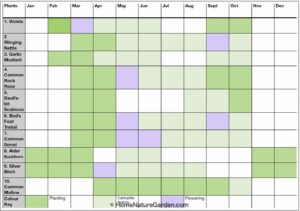
I created a calendar below, to show the planting times, the flowering season and caterpillar activity on the plants. The colour key is on the bottom row.
Conclusions
Adult butterflies feed on nectar from flowering plants. If you would like to attract butterflies to your garden as well as support their caterpillars, see my article on butterfly friendly plants for a thriving wildlife garden.
By providing both nectar-rich pollinator flowers and plant foods for caterpillars, you are supporting butterflies at every stage of their life cycle. The next step is bringing these two types of plants together in one garden.
You can learn how to do that in my next article:
A little leaf damage is a small price to pay for a garden full of butterflies.
This article will be updated with seasonal photographs of caterpillars feeding as they appear in the garden.
Common questions about about Caterpillar Feeding
Is leaf damage a bad sign?
No. Leaf damage is not a bad sign. It is a sign that your plant is supporting butterfly life. Caterpillars must feed in order to grow, and a little leaf damage is natural and necessary part of the butterfly life cycle. Healthy plants tolerate this feeding well, and the damage is usually temporary.
Should I move caterpillars?
No. There is no need to move caterpillars. They are adapted to the plant they hatch on and usually feed for only a short time before pupating and becoming adult butterflies. Moving them can cause unnecessary stress and may reduce their chances of survival.
Can I avoid pesticides and still protect crops?
Yes. Any plants you do not wish caterpillars to feed on, such as brassicas, can be protected with fine netting. This prevents egg-laying without harming caterpillars elsewhere in the garden. Avoiding pesticide allows caterpillars and butterflies to thrive.
What if I don’t see butterflies but still see damage?
Caterpillars often go unseen. They may be hiding on the underside of leaves or resting nearby during the day away from predators. They may have finished feeding and the caterpillar has pupated or emerged as an adult butterfly. The feeding signature – holes, ragged edges, or skeletonised leaves – are often the best clue that caterpillars have been present.
Will caterpillars kill my plants?
In most cases, no. Native plants are well adapted to caterpillar feeding and recover quickly. Healthy plants can tolerate leaf loss, especially when damage occurs over time.
Is it best to grow native plant foods for caterpillars
Native plants are the best choice because local butterflies have evolved with native plants. However, some non-native plants, such as common mallow, which I grow in my garden, can also be important caterpillar food plants.
Should I remove damaged leaves?
It’s best to leave damaged leaves where they are. Caterpillars may still be feeding, resting or pupating nearby, and removing them may disturb them. Tidy or remove later, after feeding has finished.
When is leaf damage likely to appear?
Leaf damage is common in spring and early summer, when caterpillars are feeding, but some species feed later in the season. Timing varies depending on the species and the weather.
Butterflies and Caterpillars in the Nature Garden – The Series.
This article is part of a series exploring how gardens can support butterflies at every stage of their life cycle, through observation, tolerance and the right plants. The article forms part of a wider wildlife garden, where caterpillars, leaf damage, and plant feeding are signs of a functioning habitat rather than a perfect display.
If you’d like to read more in the series:
- Butterflies at Risk: What Inspired my Writing on Butterflies
- Butterfly Friendly Plants for a Thriving Wildlife Garden
- 10 Plant Foods for Caterpillars & How to Spot Leaf Damage
- Designing a Plan for a Butterfly and Caterpillar Garden
- 5 Ways to Enjoy your New Butterfly and Caterpillar Garden
- 10 UK Butterfly & Caterpillar Books to Read In or Near Your Garden